Friday, February 10, 2012

MEDIC DIES


Paramedic Joshua Weissman, 33, of the Alexandria Fire Department, died Feb. 9, 2012, from injuries sustained in the line of duty. Crews from the City of Alexandria and Arlington County responded to a car fire on I-395 near Glebe Road on Feb. 8. Weissman fell from the highway into Four Mile Creek and sustained a severe head injury. He was taken to the Washington Hospital Center trauma unit.

Monday, February 06, 2012

OBAMA VISIT

President Obama meets firefighters following his remarks on the Veterans Job Corps at Fire Station No. 5 in Arlington County, Virginia, on Feb. 3, 2012.

Official White House Photo by Pete Souza

Thursday, January 12, 2012

AIR FLORIDA - 30 YEARS


Photos: National Park Service, U.S. Transportation Dept.
Jan. 13, 2012 marked the 30th anniversary of the 1982 Air Florida disaster. Arlington County firefighters were among the first to reach the 14th Street Bridge, scene of the deadly crash.


On Jan. 13, 1982, Air Florida Flight 90, carrying 83 passengers and crew, departed to the north on National Airport’s main runway at 1600 hours.

Seven inches of snow had fallen in the nation’s capital that day. The ground temperature was 24 degrees. Visibility was limited. Ice had built up on the wings of the jetliner as it waited its turn to takeoff, preventing Flight 90 from gaining altitude. The aircraft shuddered.

Below, traffic on the 14th Street Bridge was heavy as the storm led to the early dismissal of federal workers. ``With an awful metallic crack, a blue-and-white jet swept out of the swirling snow … smacked against one of the bridge’s spans, sheared through five cars like a machete, ripped through 50 feet of guard rail and plunged nose first into the frozen Potomac River,’’ The Washington Post said.

At 1605 hours, the Arlington County Emergency Communications Center received a telephone call from CB radio operator Evie White -- a member of REACT -- advising of trouble at the 14th Street Bridge, possibly an aircraft down. ``One phone call,’’ said Craig Allen, the ECC system manager. ``That’s what we had to go with.’’ Cellular phones were for the future.

At 1606, ECC transmitted Box 7503, a full first alarm assignment consisting of Engines 75, 74, and 70; Trucks 74 and 79; Medics 75 and 76; and Chief 77.

``We didn't know what we had,'' said retired Capt. Howard Piansky, who was a private assigned to Engine 75 in January 1982. ``We thought it was a small plane.''

It was much worse.

Of the 83 people on the aircraft, only a few had survived the crash into the Potomac. They were struggling in the freezing river amid ice chunks, debris, luggage, seat cushions and jet fuel. On the bridge, four people were dead or dying. Others were injured.

The District of Columbia Fire Department alarm office received word of the crash at 1607, and struck Box 417 for the 14th St Bridge. That brought Engines 13, 7, 16 and 2; Trucks 10 and 3; Rescue Squads 1, 2 and 3; Ambulances 6, 7 and 5; Medics 9 and 11; Battalion 6 and the citywide tour commander and a variety of special units.

Responding to a call on the ``crash phone’’ from the airport tower, the National Airport Fire Department sent two rigs – Red 373 and Red 397 - to the end of the Runway 18. Two other rigs – Red 376 and Red 396 – headed north on the George Washington Memorial Parkway, which runs parallel to the river, toward the bridge.

Treacherous highways

Getting to the scene was treacherous because of the snow and ice and the volume of commuter traffic on both sides of the river. Engine 75 stalled en route, and Piansky and the rest of the crew headed for the river on foot – arriving in time to help survivors brought ashore. Other fire companies were delayed in traffic on both sides of the river.

Subsequent alarms and special calls brought more help, including Medic 71, Medic 74, Chief 71 and Chief 73 from Arlington, Medic 62 from the airport, Medic 56 from Alexandria, a foam truck from Fort Myer, and the fireboat John Glenn from the district. Additionally, Fairfax County, Loudoun County and Montgomery County sent mutual aid. Dulles airport dispatched two crash rigs, Red 360 and Red 361.

Police played a crucial role.

The U.S. Park Police helicopter Eagle 1 arrived over the river at 1620 to assist in the rescue effort, having lifted it off from its base five minutes earlier. Hovering over the river surface, the chopper plucked four survivors from the ice and carried them to the Virginia shoreline. On land, firefighters and paramedics wrapped the survivors in blankets and escorted them to ambulances.

Lenny Skutnik and others

There were other heroics. A passerby, Lenny Skutnik, 28, who worked at the Congressional Budget Office, dove into the river and rescued a woman who was too weak to hang onto a rescue line. ``She was screaming `Would somebody please help me!’’ Skutnik told The Post.

Firefighter John Leck, of D.C. Truck 3, also went into the water. ``Without hesitation and regard for his own safety, he secured a lifeline around his waist and entered the freezing water which was contaminated with jet fuel,’’ according his superior, Lt. Daniel O’Donnell. ``He swam to the injured woman and kept her head above water until the members on the river bank pulled them to safety by means of the lifeline.’’ O’Donnell’s report was published in the newsletter of the International Association of Fire Fighters.

The last survivor of the crash – a balding, middle aged man - vanished in the river after passing the helicopter lifeline to the others, the greatest act of heroism that day. As the Post reported: ``To the copter’s two-man Park Police crew, he seemed the most alert. Life vests were dropped, then a flotation ball. The man passed them on to the others. On two occasions, the crew recalled … he handed away a lifeline from the hovering machine that could have dragged him to safety.’’

That man was later identified as Arland Williams -- and one of the bridge’s spans was named in his honor. An autopsy showed Williams was the only victim to drown. The others suffered traumatic injuries.

On the 14th Bridge itself, the members of Engine 74, Medic 75 and Medic 71 marked on the scene at 1615 and began treating casualties and working to free motorists from the wreckage of their vehicles. Medic 75 called for 10 additional medic units.

'Like a battle zone'

Flight 90’s landing gear crushed several cars and tipped a large truck. ``It was like a battle zone,’’ said retired Firefighter Chuck Satterfield, who was driving Engine 74’s wagon. ``They kept saying it was a small plane – a private plane.’’

Engine 74, under the command of Capt. Mike Dove, had just cleared a call for alarm bells in Rosslyn. Wanting to avoid heavy traffic on Wilson Boulevard, Satterfield and Dove decided to use a roundabout route to get back to their station in Clarendon. That decision helped put them on an almost clear course for the bridge when alarm was sounded.

Once on the bridge, Engine 74’s crew tended to an Air Force captain pinned in a car. ``He was alive but died later,’’ Satterfield said.

Some of the other victims were obviously dead. Their bodies were covered with tarps and removed later. The expression of death on the face of one victim suggested he saw the plane descending toward the bridge.

Even though Arlington County firefighters were among the first on the bridge, a D.C. fire chief who arrived at 1630 requested that they leave because the river was within his jurisdiction, according to a task force report on the disaster.

Arlington Fire Chief Thomas Hawkins ``directed that a staging area be set up on the GW Parkway,’’ the task force report said.

At about the same time, police and firefighters started recovering the dead from the river. Within the first hour, two dozen bodies had been brought ashore. ``It was an absolutely ghastly sight,’’ said John Gamble, a volunteer firefighter quoted by the Post.

Recalling that surreal scene almost two decades later, Piansky said there was little left to do after the survivors had been pulled from the river and sent to hospitals.

Most of the passengers and crew died on impact, some still strapped to their seats in the submerged fuselage. ``It was a helpless feeling,’’ Piansky said.

In the hour or so after the airplane crashed, Arlington 911 received only one other fire or EMS call, Allen said. It was ``an OB’’ – a woman had gone into labor in the far northeastern part of the county, he said. A new life was about to begin.

Metrorail accident downtown

Meantime, another deadly drama was unfolding in downtown Washington. At 1640, the D.C. fire alarm office transmitted Box 484 for a derailment in a subway tunnel between Federal Triangle and Smithsonian stations. That alarm brought out Engines 23, 3, 1 and 18; Trucks 1 and 2; Rescue Squad 4; Battalions 2 and 7; and the Salvage and Air Unit.

Metrorail personnel were attempting to reverse an eastbound train that had crossed over to the westbound track, when the lead car smashed into a concrete bulkhead – splitting the train open. Emergency lighting failed and plunged the train into darkness.

Transit police officer Terry Rylick, who was riding in the subway car that derailed, radioed the initial call for assistance.

As the magnitude of the accident became apparent, Engines 8 and 9, Truck 4, several medic units and ambulances, were sent to Box 484. In some cases, fire and EMS units were diverted from the 14th Street Bridge.

Responding to a call for mutual aid, Prince George’s County sent Rescue Squad 22, several ambulances and a medic unit.

The Metrorail accident claimed several lives and injured about two dozen people. In all 1,200 commuters were evacuated from the tunnel.

Friday, December 02, 2011

RIGHT TO VOTE

"On Nov. 8, 1960, members of Rescue 6 were called upon to transport a resident from Anderson Clinic to Mt. Daniel Elementary School, her local polling place, to vote," according to the Falls Church Volunteer Fire Department website.

WAITING FOR RUN

Arlington County Fire Department Capt. Sam Krigbaum (seated) and Firefighter Jack Higgins waiting for a run in the kitchen of the old Clarendon firehouse. This December 1955 photo is from the collection of Capt. Randy Higgins.

Thursday, December 01, 2011

FIRE STATIONS

New No. 3 - Cherrydale Fire Station - Opened 2011

APPARATUS ROSTER

No. 1 - Glebe Road - E101, M101, B111, Hazmat
No. 2 - Ballston - E102, M102, EMS102, Command Unit
No. 3 - Cherrydale - E103, B112, Bomb Squad
No. 4 - Clarendon - R104, T104, M104
No. 5 - Crystal City - E105, T105
No. 6 - Falls Church - E106, T106, M106, Volunteer Units
No. 7 - Fairlington - E107
No. 8 - Halls Hill - E108
No. 9 - Walter Reed - E109, R109, M109
No.10 - Rosslyn - E110, M110, Technical Rescue
No. 61 - Fort Myer (U.S. Army) - E161
No. 301 - National Aiport (Airport Authority) - ARFF

E = Engine
T = Truck
M = Medic
EMS = EMS Supervisor
B = Battalion Chief

Thursday, November 24, 2011

HELP WANTED

Do you have a photo, newspaper clip or story to share? Please contact the Fire Journal at wb2kqg@arrl.net

Friday, October 21, 2011

ROSSLYN - 1945


The Virginia shoreline burst into flame on Dec. 9, 1945.

"The early-Sunday quiet of Rosslyn, Va., was spectacularly broken when a 5000-gallon runaway truck-trailer loaded with high test gasoline crashed into a parked milk truck and exploded," The Washington Post reported the next day.

Eight Arlington County volunteer companies answered the alarm and the District of Columbia Fire Department sent 16 pieces of equipment.

"Blazing gasoline roared through a storm sewer into the Potomac, setting the surface of the river ablaze," the Post said. "The district fire boat was rushed to the scene to prevent the flames from reaching oil barges tied up near Key Bridge."

The Arlington Trust Co. building was gutted, storefronts within 200 feet were scorched and a black cloud hung over Rosslyn and Georgetown.

And yet no one was hurt in the inferno.

Lee McCanless, 26, of Baltimore, driver of the E. Brook Maitland Oil Co. tractor-trailer, said his brakes failed on the Key Bridge.

"Right after the crash the flames started blazing up all over the trailer," said McCanless, quoted by The Washington Post. "They shot up twice the height of the bank."

His face and clothes blackened, McCanless jumped free and ran across Rosslyn Circle to safety.

Andrew Kovat, 37, of Hyattsville, driver of the Thompson Dairy truck, was across the street at the Rosslyn Lunchenoette, eating breakfast.

The newspaper called Kovat's breakfast "a meal which probably saved his life."

Monday, October 17, 2011

BOX 7209

Photo: Lt. Kramer via acfd3.com
On May 9, 2009, fire gutted a house at 5531 North 5th St.

FISHER'S NIGHT - 1928

UPDATED OCTOBER 2011

By Vinny Del Giudice
Editor, Arlington Fire Journal


Volunteer firemen from Arlington County rolled into Washington, D.C. on the night of Jan. 16-17, 1928, after an arsonist named John J. Fisher set a series of blazes that tested the entire city fire department as well as crews from as far away as Baltimore - an episode remembered for years as "Fisher's Night."

Deputy Chief Philip Nicholson of the District of Columbia Fire Department called it the wildest night of his career. Suspecting one or more "fire bugs" were on the loose, the Metropolitan police assigned officers to guard lumber yards and other inviting industrial targets.

Not since British troops set fire to the city in August 1814 had such a conflagration visited Washington. ``As fast as companies could be spared, they were dispatched from one fire to the other,'' Nicholson said.

So many firefighters collapsed from the smoke and exhaustion, that they overwhelmed Emergency Hospital. Doctors ran out of a medicinal whiskey, a common anecdote at that time, the supply of which was restricted by prohibition laws. With the blessing of the police, the doctors put out a call to bootleggers for more.

Fisher, 34, a former psychiatric patient, policeman and veteran of World War I, said an ``irresistible impulse'' led him to set the fires.

Bells clanged and sirens pierced the night.

"Five extra alarm fires, interested with several minor ones and a few false ones, threw the national capital into a state of turmoil," The Associated Press reported.

The largest of the fires swept a Woolworth's ``Five and Dime'' store at 9th Street and Pennsylvania Avenue, Northwest, within sight of the Capitol. Firefighters had the upper hand on the Woolworth's blaze until the flames set a gas line alight.

Businesses along the city's ``Produce Row,'' located near the old Central Market, also went up in flames, as did businesses in the city's northeast quadrant. The smallers fires and false alarms "kept firemen on a constant procession during the night," the Associated Press reported in a story printed in the St. Joseph News-Press of Misouri.

In 1928, the District of Columbia Fire Department fielded more than 50 companies - engine, hook and ladder and rescue - that operated from about 30 firehouses. All its men were paid. The firehouses were divided between six battalions (Battalions 1-5 and the ``Central Battalion'' downtown.) The Virginia and Maryland suburbs, in the meantime, were protected by independent volunteer fire departments.

The headline of The Washington Post reported that firefighters were pushed to the limit:

BIG BLAZES DAMAGE
BUSINESS AREA BUILDINGS;
FUMES SICKEN FIGHTERS

Flames in Produce Row and
Ten-Cent-Store Exhaust Apparatus

An Associated Press wire dispatch in The New York Times on Jan. 18 reported:

``Twenty-four fire alarms worked Washington up to fever heat between midnight and noon and scurried the entire city's fire fighting forces and those of other cities to a dozen blazes in different sections of the capital.

``Taking stock of the unprecedented situation, officials found that more than thirty firemen had been slightly injured and property damaged to the extent of several hundred thousand dollars.''

A history of the D.C. Fire Department (posted on the city's website) said: ``It had become obvious that a maniacal arsonist was on the loose.''

Baltimore, 40 miles to the north, sent help and its ``fire forces helped fight two of the big blazes, manned fire houses for protective purposes, and, incidentally paid a twenty-four-year-old debt to the capital which helped Baltimore combat its big fire of 1904,'' the AP reported.

``Ten companies, an ambulance and several deputies made the long run from Baltimore and furnished an unusual spectacle of blazing engines and screeching sirens,'' the AP said.

(In the Great Baltimore Fire of Feb. 7, 1904, flames burned for 30 hours over 140 acres, destroying 1,500 buildings and at least 2,500 businesses. That conflagration was many times more serious than ``Fisher's Night,'' causing $100 million in damage in 1904 dollars, according to the Baltimore City Fire Department website. Additionally, the Baltimore fire was an accident - started by an explosion at the John E. Hurst Co.)

The alarms bells in Washington's firehouses tapped out round after round on Fisher's Night.

To report a fire, citizens public pulled levers on street corner Gamewell boxes - typically painted red, topped by a light and assigned a unique box number. Inside the boxes were a spring wound movement, and when the box was pulled, four rounds of the box number rang into the alarm office.

``Running cards'' listed the units ``due'' at each box alarm.

Fire officers used telegraph keys in the boxes to request more men and equipment (second alarm, third alarm, etc.) and also carried telephone sets that could be connected to the boxes to speak to the alarm office.

Among the major fires on Fisher's Night:

· Box 191 was struck at 10:41 p.m. on Jan. 16, 1928, for a basement fire at the Woolworth's 5 and 10 Cent Store at 923-925 Pennsylvania Avenue, Northwest. The fire went to five alarms, and a number of firefighters were injured when a gas main ruptured.

· Box 152 was struck at 12:32 a.m. on Jan. 17 for the Commission Houses at 204-206 and 208 10th Street, Northwest, where many of the Virginia firefighters were put to work, according to The Washington Post. The fire went to two alarms.

· Box 647 was struck at 1:54 a.m. for the Pillsbury Feed Warehouse, 54-58 North Street, Northeast. The fire went to four alarms.

· Box 664 was struck at 3:37 a.m. for the vacant McDowell Feed Warehouse at 1530 Eckington Place, Northeast. The fire went to three alarms.

· Box 89 was struck at 5:11 a.m. for a mill at the rear of 1319 W Street, Northwest. The fire went to four alarms.

Police arrested Fisher after he threatened a man who attempted to pull Box 89, at the corner of 13th and W Streets, Northwest - two miles north of the first fire.

Said an Associated Press printed the Evening Tribune of Providence, Rhode Island:

"Firemen fell so rapidly under the stiffling smoke at the Woolworth and produce stores, where scores of live chickens burned, that ambulances were not able to carry them all to the hospital. An emergency first aid station was established close to the fires and many firemen were treated there, going back to the hose lines after recovering.

"At Emergency Hospital an nunusal situation was reported to have developed when doctors found the institution's stock of whiskey inadequate. Word went forth that bootleggers be sent in and police officers were said to have agreed not to molest any venturing inside the building. There was no record whether purchases were made from the bootleggers, however."

The next day, Jan. 18, 1928, The Washington Post reported:

``Confessing to touching off two of the disasterous fires which spread horror through the city Monday night and yesterday morning, John J. Fisher, of 716 Roxboro Place Northwest, told police of the Thirteenth Precinct last night that he was moved by an ``irresistible impulse.''

That night, Fisher was moved from the D.C. Jail to the ``psychopathic ward'' at the old Gallinger Hospital.

The Post's headline read:

ARSON DEFENDANT TAKEN
TO HOSPITAL FOR
MENTAL STUDY

Alieniests at Gallinger are to Observe
Fisher Ten Days Before Reporting

Lunacy Proceeding Planned if Veteran's
Mind is Found Unsound

In February 1928, a grand jury indicted Fisher on two counts of arson and a court committed him to St. Elizabeths, the city's mental hospital, that May, according to The Washington Post. In 1931, Fisher requested to be released from St. Elizabeths.

His request was denied by the court.

St. Elizabeths was established in 1855 as the Government Hospital for the Insane by reformer Dorothea Dix to provide the ``most humane care and enlightened curative treatment of the insane of the Army, Navy, and District of Columbia,'' according to the U.S. National Library of Medicinel. Congress officially changed the hospital's name to St. Elizabeths in 1916. In colonial times, the site had been called St. Elizabeths by locals.

Writing in his 1936 history of the D.C. Fire Department, Chief Nicholson shared his recollections of Fisher's Night:

``There were five additional alarm fires, all practically burning at the same time, in other words before any of the reserve companies were sent home from the first fire, another alarm would be sounded which necessitated the sounding of additional alarms, until five additional alarms were in progress at the same time.

`` As fast as companies could be spared, they were dispatched from one fire to the other. In this case there was not a company left in any engine house, for the protection of the city.

``At this point, aid was requested from Baltimore, and ten companies, in command of Deputy Chief Reinhardt, responded and they with the volunteer companies from nearby Maryland and Virginia, responded and were assigned to different houses, responding to some of these fires and to other smaller fires that occurred … These extra companies did excellent service, for which District officials were very grateful and so expressed themselves in proper form.

``The writer was off duty that night, and was just starting to leave the Willard Hotel, where he attended a meeting of the Board of Trade. My attention was attracted by the speed and direction (of the engines and hose wagons) … So out of mere curiosity – second nature – I followed and was not long in finding out.''

Fisher, it turned out, had a long history of fire setting.

On Jan. 22, 1928, The Washington Post published an interview with Fisher:

Pyromaniac and War Hero Describes How His Craze Made Him Set 100 Fires

Started When 9-Year-Old School Boy,
Joseph Fischer Says

Burned Homes and Haystacks
Behind Battle-lines

Happiest When Shells Made France Inferno

Fought Duels With Pal for Thrills

In the psychopathic ward at Gallinger Hospital yesterday afternoon a mild mannered, clean cut appearing young man sat on the edge of a cot and related the story of a strange obsession which seized him when he was a 9-year-old schoolboy, clung to him for 20 years and caused him to set fire to more than 100 homes, warehouses, lumber yards and business establishments.

Doctors diagnosed Fisher suffered from pyromania - a rare psychiatric disorder.

CHIEF & TRUCK

Photo: acfd3.com

Tuesday, September 06, 2011

9/11 A DECADE LATER

THE ARLINGTON FIRE JOURNAL SALUTES THE MEN AND WOMEN WHO RESPONDED TO THE PENTAGON IN SEPTEMBER 2001

Monday, May 02, 2011

5/2/2011


On May 2, 2011, Osama bin Laden, the man who inspired the Sept. 11, 2001, attacks on the Pentagon and the World Trade Center, was killed by Navy SEALS in Pakistan.

Thursday, April 28, 2011

'BOY FIREMAN' - 1925

For six months, George Washington Whalen, 16, a volunteer fireman from the City of Alexandria, clung to life after suffering injuries at his first and last alarm.

Whalen - who the newspapers admiringly called "boy fireman" - fell into the hull of a ship during a fire at Jones Points Shipyard on Aug. 2, 1924 and fractured his spine.

Rescuers found him in water up to his neck.

He died Feb. 20, 1925 at Alexandria Hospital.

Firemen and friends raised money for his family, presented him with a radio set for his 16th birthday and supplied a Christmas tree and holiday gifts.

"His case was hopeless from the the first," The Washington Post reported. "The fact that he survived his injuries so long has been a source of wonder to his physicians."

A photograph in a book about the Alexandria Fire Department showed Whalen's funeral procession, led by a hose wagon carrying his casket.

BREWERY FIRE -1910


On Jan. 12, 1910, a watchman, a constable and another man freed 40 horses from a stable fire at the Arlington Brewing Company in Rosslyn - and "the animals ran wild through the streets," The Washington Post reported. As there was no organized firefighting in Rosslyn, the District of Columbia Fire Department sent sent Engines 1, 5 and 9 and Truck "E" across the old Aquaduct Bridge.

Tuesday, April 26, 2011

BOMB SQUAD

In 2011, a Bomb Squad was added to the Arlington County Fire Department fleet of special units. The fleet also includes a HAZMAT Unit, a Technical Rescue Unit and a Mobile Command Unit.

LESLIE HUGHES - 1956

On July 22, 1956, an Arlington County firefighter hurt at a blaze at the Henderson Hall Marine Barricks saved a Marine injured at the fire - in the ambulance taking them to Arlington Hospital!

Leslie Hughes "struggled up" from his cot to administer artificial respiration to Marine Sergeant Hackett, The Washington Post said.

Another firefighter, Guy Swarthouth, administered oxygen to Hackett, who was "out for about five minutes," said Hughes, who returned to the fireground.

The blaze damaged the Henderson Hall theater building.

Firefighters from Arlington County, Fort Myer and Henderson Hall - supplemented by 200 off-duty Marines - extinguished the flames, the Post reported.

LAZO & CARTER KIDS

UPDATED OCTOBER 2011

Two days before Christmas in 1934, two children perished in a house fire in Arlington County - a holiday tragedy that would be repeated a decade later.

Richard Lazo, 7, and his sister Peggy, 3, were alone on the second floor of the family's two-story frame home on Malvern Place in Thrifton Village, according to The Washington Post.

(Malvern Place is no longer on the map. The Arlington Fire Journal first learned of this fire from the late James Fought, a former volunteer and retired battalion chief, who said the fire was on North Edgewood Street.)

Neighbors turned in the alarm at 8:50 p.m. on Dec. 23, 1934.

Flames poured from the windows when the first engines arrived.

Clarendon Fireman George Watts found little Peggy Lazo in her crib "gasping from the smoke," and Captain Orlando Crigbaum carried her outside, according to The Post. She died enroute to Georgetown Hospital.

Fireman Watts then located the body of Richard Lazo, who "left his bed and in his terror wandered straight into the flaming rooms," the newspaper reported.

The parents, Manuel and Annette Lazo, were located at Lazo's real estate office on Wilson Boulevard in Clarendon. The residents of the first floor, Mr. and Mrs. W.C. Jansen's, were at church.

Sixty firefighters and "all available fire apparatus in the county rushed out to fight the fire, which devoured furniture and stripped the walls of the apartment, living room and kitchen," the Post reported.

The parents built a "fire-proof" new home at 404 North Nelson Street, according to an Arlington Fire Journal reader.

It's not far from their childrens' graves.

The reader, Sandy Mendyk, tells us:

"I had heard a story about the fire from a woman who lives at 404 North Nelson Street when talking to her about her stone house. She said the builders of the home had it constructed of stone and steel because they had lost two small children in a fire.

"She said the children were buried at Columbia Gardens Cemetery near the dead end of Nelson Street that used to extend into the cemetery. She added that when the parents lived on Nelson Street, they used to visit the graves of the children every day.

"I recently found the graves of the Lazo children at the location the present resident described. Richard Henry Lazo was born in 1927, his sister Peggy Anne Lazo in 1931."

On Christmas Day 1934, The Washington Post published a dispatch from the Associated Press in Richmond that holiday mishaps - auto wrecks, an explosion and fires - claimed 12 lives across Virginia, including the Lazo children.

A decade later, another tragedy - eerily familiar:

On Dec. 12, 1944, an exploding stove killed three children left alone in their frame home at 1520 South Vermont Street.

Julie Carter, 5, and her brothers Sidney, 3, and Garland, 2, were buried in a single casket, according to The Washington Post.

INCIDENTS OF NOTE

LADDER RESCUE: On Jan. 14, 1954, Arlington County firefighters rescued two children from a house fire at 1639 North Woodstock Street. Caroline Justice, and her sister Alice, 6, were carried down a ladder to safety, The Washington Post reported. Their father, S. Marion Justice, tried to reach the girls before the fire department arrived. Their mother and sister, Jeanette, 10, escaped, according to the newspaper.


THOUSANDS FLOCK TO FIRE: On May 24, 1933, a two-alarm fire visible from downtown Washington erupted at an Arlington County salvage yard and attracted thousands of gawkers. "Washingtonians and Virginians flocked from miles around to witness the spectacular fire," The Washington Post reported. "Traffic was at a standstill on Memorial Bridge. Hundreds lined river drives through Potomac Park to watch the flames." The Arlington Volunteer Fire Department answered the initial alarm. The second alarm summoned fire crews from the old stations at Jefferson District, East Arlington, Clarendon and Ballston.


CLOSE CALL: On Nov. 10, 1949, an airplane carrying U.S. Vice President Alben Barkley came within 50 feet of colliding with a blimp over the Pentagon, according to an Associated Press dispatch. Barkley's flight landing safely at National Airport. the blimp was used for "advertising purposes," AP reported.

HELP WANTED

Do you have a photo, newspaper clip or story to share? Please contact the Arlington Fire Journal at wb2kqg@arrl.net

Thursday, January 20, 2011

MURPHY & AMES - 1951


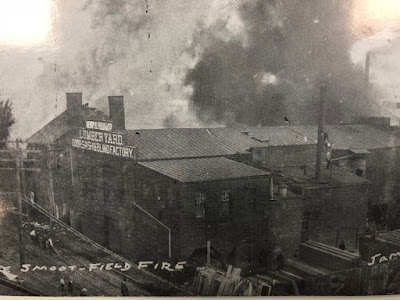
A spectacular fire broke out at the old Murphy & Ames lumber yard in Rosslyn on the night of Friday, Dec. 28, 1951.

The first alarm was transmitted at 9:15 p.m. and at the height of the blaze, the flames were visible for miles.

"I was out in Merrifield and I could see the smoke and the glow - so I followed it," said retired station commander George Kirschbaum, at the time a volunteer. "It looked like all of Arlington was on fire." Veteran volunteer Harold LeRoy also saw the glow from Alexandria.

With all of Arlington's fire crews pressed into service, the inferno brought the first test of a mutual aid agreement approved by Congress and the state legislatures of Virginia and Maryland, said John Paul Jones, a former president of the Arlington Volunteer Fireman's Association, quoted by The Washington Post.

Firefighters from Alexandria, the District of Columbia and Montgomery County answered the alarm. In all, 42 pieces of apparatus responded to the general alarm, and "at least 200 firemen, including volunteers" battled the blaze in bitter winter cold, said Deputy Fire Chief Percy Finisecy, who was quoted in the Dec. 30 edition of the Post.

Besides the devastation at the lumber yard, firefighters contended with embers that threatened wood frame homes in the neighborhood. Some crews were assigned exclusively to brand patrol.

Even old Rescue Squad 5 was scorched. "I remember pulling the seat out because it was on fire," LeRoy recalled. The heat melted hundreds of glass panes at the Geophysical Instrument Co. and firefighters played fire streams on that building to prevent the fire from spreading.

The flames also scorched nearby power lines, forcing the Potomac Electric Power Co. to cut power to Rosslyn and Fort Myer.

William Clark, a volunteer at Company 1, was the senior operator on duty at the PEPCO substation across the Potomac River in Georgetown. While he couldn't leave his post, he had a good view of the blaze -- and threw the switch to cut power to the area. "I wanted to go but I couldn't," Clark said.

The fire was declared under control at midnight.

Salvage and overhaul operations continued into Saturday as each stack of wood was broken down and wetted. Damage was estimated at $300,000.

SCHOOL FIRE - 1960


Photos: www.acfd3.com

The old Congressional School went up in flames on Feb. 17, 1960.


The two-story, fieldstone structure - at North 12th and Nash Streets - was originally built as the residence of General George Patton, the World War II hero.

The fire was discovered at about 5 p.m. after most of the students and faculty had left for the day. Principal Lillie Long smelled smoke. Fred Nibblins, a custodian, opened a closet door and was driven back ``by dense black smoke and jets of flame which seemed to be licking down from the attic,'' The Washington Post said.

Switchboard operator Natalie Manning telephoned the fire department as custodian Nibblins tried to fight the blaze with fire extinguishers. A passing motorist, Army Sergeant John Comeaux, stopped to help Nibblins fight the fire. It was to no avail.

Conditions deteriorated rapidly. ``You couldn't see anything in there,'' retired Battalion Chief James Fought recalled.

Amid the chaos, Lieutenant Fred Bryan of Company 2 almost lost his life in the fire. Bryan fell unconscious inside the school after his breathing apparatus became disabled. ``Trapped for 10 minutes, Lt. Bryan was pulled out of the attic by fellow firemen and carried down the extension ladder,'' The Washington Star said.

Bryan was revived and taken to Arlington Hospital where he recovered from his injuries.

Three other members of the fire department - Captain Arthur Willett, Inspector Robert Buckrop and Firefighter David Dant - were treated at the scene for minor injuries, the Post said.

A volunteer from Company 2, Bob Gill, was also trapped for a time but got out safely with the help of other firefighters.

The fire was declared under control at about 6:05 p.m. by Fire Chief Joseph Clements. Damage estimated at $100,000 to $200,000. In all, 15 pieces of apparatus answered the alarm.

Fire Marshal Leslie Shelton told the Star the fire started in the attic ``and burned for quite a while unnoticed.'' Malcolm Devers, president of the Congressional Schools of Virginia, said defective wiring probably caused the blaze.

According to school folklore, snacking squirrels damaged the wires.

At the time, the building housed the kindergarten through third grades. Classes for the upper grades were held at the school's Fairfax County campus. After the fire, all grades were moved to Fairfax County.

RESCUE 6

Photo: Falls Church Volunteer Fire Departnment

Friday, December 17, 2010

CAPITAL AIRLINES - 1949


On a foggy evening in 1949, a Capital Airlines DC-3 crashed in the Potomac River as it attempted to land at National Airport from the north. Four people died, including the pilot and co-pilot of Flight 500. Sixteen others survived the Dec. 12 crash. Firefighters on the Virginia side of the river could hear their calls for help. Boats from Bolling Air Force Base in Washington located the wreckage and rescued the victims. The Civil Aeronautics Board concluded "the probable cause of this accident was the stalling of the aircraft."

Thursday, December 09, 2010

VEPCO FIRE - 1960

Aug. 8, 1960
Courtesy of the Falls Church VFD

Monday, November 15, 2010

SEMINARY FIRE - 2010

Photo: Episcopal Cafe

On Oct. 22, 2010, Arlington County sent mutual aid to a two-alarm fire that destroyed the chapel at the Virginia Theological Seminary in the City of Alexandria.

The chapel was built in 1881 and used for daily worship. The cause of the fire was ruled accidental. There were no injuries.

“Because of the safe and effective firefighting operations by Alexandria and our partner jurisdictions, we were able to save the adjacent historic structures as well as a number of irreplaceable religious artifacts,” said Adam Thiel, chief of the Alexandria Fire Department, in a press release.

The initial alarm was received at 3:49 p.m.

Tuesday, October 12, 2010

BONDS OF 9/11

Photo: ARL Now web site
On Aug. 29, 2010, the New York City Fire Department presented the Arlington County Fire Department with a steel girder from the ruins of the World Trade Center to commemorate the attack on the Pentagon on Sept. 11, 2001. The ceremony was held at Fire Station No. 5 in Crystal City, the nearest county fire station to the Pentagon.

AIRPORT DRILL - 2010


Photos: WTOP
On Sept. 18, 2010, firefighters from across the Washington region participated in an emergency exercise at Washington National Airport.

Wednesday, July 07, 2010

WAGON 5

Photo: www.acfd3.com

Wagon 5 - a 1948 American LaFrance - at the old Jefferson District firehouse. (Crystal City)

Wednesday, June 02, 2010

COMMAND UNIT

Arlington County Fire Department command unit

Vehicle specifications for Arlington County Fire Department command unit, manufacturered by E-One.

Body Model: Rescue/SpecialtyBody
Material: aluminum
Cab Make/Model: Spartan Gladiator E/R#
Cab Seats: 2
Engine Brand/Model/Horsepower: Cummins ISC 350
Transmission Brand/Model: Allison MD 3066P
Generator Make/Capactiy: Onan 35kw PTO, Powertech 20 kw Diesel

Wednesday, May 12, 2010

LEXINGTON ST. - 2009

House Fire - 2009
North Lexington Street
From IAFF2800.com

Tuesday, April 27, 2010

FUNDS RESTORED

On April 24, 2010, the Arlington County Board voted to restore $1.5 million to the county budget - allowing the fire department to continue to operate two heavy rescue companies, according to The Washington Post.


Monday, April 12, 2010

FRANK HIGGINS


"It is with great sadness, I announce the passing of FRANK R. HIGGINS. Frank passed away April 9, 2010. Frank served the Arlington County Fire Department as a firefighter, the Clarendon Volunteer Fire Department as an Officer and Past President."

Charles Satterfield, President
Clarendon Volunteer Fire Department

Friday, March 05, 2010

PENTAGON SHOOTING

On March 4, 2010, the Arlington County Fire Department responded to a shooting at the Pentagon that injured two police officers and led to the fatal wounding of the gunman. Engines 105 and 110, Truck 105, Medics 105, 101 and 110, Battalion 111 and EMS 111 were assigned to the call.

Thursday, February 11, 2010

FORT MYER - 1918

Photo: www.firetrucks-atwar.com
Scene at U.S. Army's Fort Myer in Arlington, Virginia, in 1918.

GREEN STAMPS - 1960

Photos: Falls Church Volunteer Fire Department
On Nov. 6, 1960, firefighters from Falls Church and Fairfax County battled a fire at the S&H Green Stamps Store on Hillwood Avenue in Falls Church. One man was injured. The fire companies names in the original caption are No. 6 Falls Church, No. 18 Jefferson and No. 10 Bailey's Crossroads.

CHICKEN OR STEAK?

Photo: Falls Church Volunteer Fire Department
Arlington County Fire Department training bureau van at shopping center on Columbia Pike in 1986.

BLIZZARD OF 2010

FLASHBACK - Knickerbocker Storm of January 1922. Theater collapse killed 98 people in Washington, D.C.

Photo: www.acfd3.com
Ready to roll for blizzard duty. Apparatus floor at Arlington County Station 106 in Falls Church, including National Guard wrecker at center and the volunteer's venerable Light & Air 103 in the foreground. Also in photo - Truck 106, volunteer ambulance and rescue company.

Apparatus floor at Fairfax County Station 410 in Bailey's Crossroads after roof collapse on Feb. 8, 2010. There were no injuries. The structure gave way at 3 a.m. while the platoon was in the bunk room. Station 410 covers parts of Arlington.

The Washington area was pounded by back-to-back winter storms between Feb. 5 and Feb. 11, 2010, forcing the closure of the federal government, airports, schools and businesses. Commercial power and mass transit were also disrupted.

The snowfall set a seasonal record of 54.9 inches of snow at National Airport in Arlington, according to the National Weather Service. Forecasters compared the snow to the Knickerbocker Storm of 1922, which caused the collapse of a Washington movie house called Crandall's Knickerbocker Theater. That catastrophe killed 98 people and injured 133 others.

During the Blizzard of 2010, the emergency services operated in hazardous conditions, and the National Guard loaned a heavy-duty wrecker to the Arlington County Fire Department. The giant vehicle was assigned to Fire Station 106 in Falls Church.

On Feb. 8, the snowfall caused the collapse of the roof over the apparatus bay of Fire Station 410 in Bailey's Crossroads in Fairfax County. There were no injuries. The structure gave way at 3 a.m. while the platoon was in the bunk room.

According to the Fairfax County Fire Department: "Firefighters were alerted by a loud screeching noise in the apparatus bay. A fire engine, ladder truck, three EMS units, and a utility truck were all extensively damaged. Several personally owned vehicles parked next to the station were totaled."

The Bailey's Crossroads firehouse, which provides service to parts of Arlington County, was built in 1974 and the roof was replaced in 1998.

Fire stations in Annandale and Alexandria also sustained roof damage, according to news reports.

  • BLIZZARD ALERT! Keep neighborhood fire hydrants clear of snow and ice - and easily visible to firefighters in the event of a fire. Adopt a fire plug!